

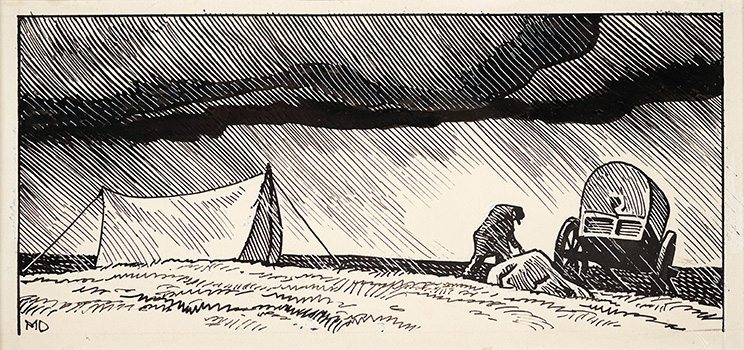
Storm on the Plains, Maynard Dixon (1875-1946), Illustration for “The Oregon Trail” (pg 32), 1943, The Hilbert Museum of California Art at Chapman University, Gift of The Edward H. and Yvonne J. Boseker Collect
North Wing
Witness to a Vanishing West: Maynard Dixon and The Oregon Trail
February 7, 2026 – November 1, 2026
In 1927, near the end of a remarkable career, Maynard Dixon undertook what would become his last major illustration commission: a cycle of drawings for a new edition of Francis Parkman’s classic 1849 travel narrative, The Oregon Trail. The resulting works — nine of which are on view in this exhibition — stand among Dixon’s most evocative and mature achievements. At once historically grounded and poetically restrained, they reflect the artist’s lifelong engagement with the landscapes, peoples and fading traditions of the American West.
These rare original drawings come to the Hilbert Museum of California Art as a generous gift from Orange County-based collector Yvonne Boseker, who also donated the accompanying vintage copy of the book for which they were created.
Together with a selection of Dixon paintings from The Hilbert Collection, this exhibition offer a unique opportunity to encounter an artist who did more than depict the West: he bore witness to its passing.
A Life Shaped by the West
Born in Fresno, California in 1875, Lafayette Maynard Dixon grew up in an environment still deeply marked by frontier life. His father, a Confederate veteran and newspaperman, instilled in him a love of history and storytelling, while the vast open spaces of California’s Central Valley and the nearby Sierra Nevada left a lasting visual impression. By his late teens Dixon was working as a professional illustrator, and by the early 1900s he had begun the westward journeys that would define his art.
Dixon traveled extensively throughout the Southwest, often on horseback, immersing himself in the lives of Native American communities, Hispanic villages, ranchers, cowboys and itinerant workers. Unlike many artists of his generation who romanticized the West from a distance, Dixon lived it. He sketched on location, slept under the stars, and observed with patient attention the rhythms of desert light, weather and human labor.
Over time, his style evolved from detailed illustration to the bold, modernist forms for which he is now celebrated: sweeping compositions, simplified geometry, monumental skies, and figures reduced to essential gestures. Yet no matter how modern his visual language became, Dixon’s subject remained constant: the land and its people at the edge of transformation.
Tickets/Reservations
The Hilbert Museum recommends FREE online reservations for entry. Guests who arrive without a reservation will be assisted by our staff as available and admitted as space permits. We look forward to seeing you!