

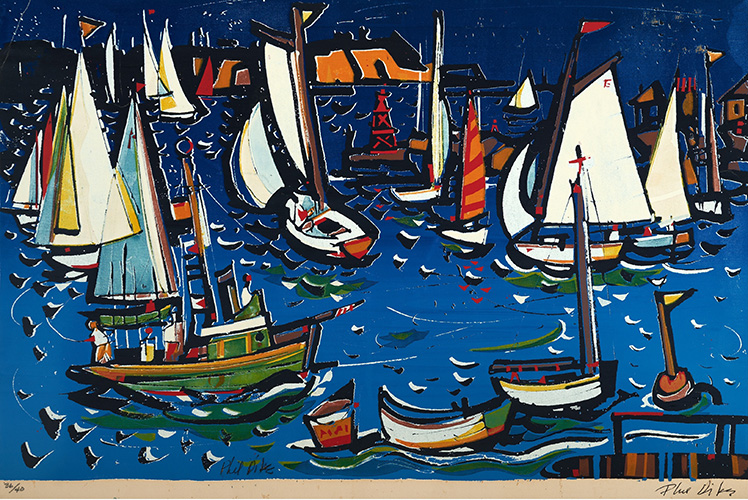
Boats in the Harbor (Balboa Byzantine Style), Phil Dike (1906 – 1990), 1950s, Serigraph, The Hilbert Collection
North Wing
Harbors and Horizons: Maritime Prints by Phil Dike
February 7, 2026 – October 4, 2026
Phil Dike (1906-1990) was one of Southern California’s most accomplished and respected artists, known nationally for his work in watercolor, oil and printmaking. Born in Redlands, California, Dike developed an early sensitivity to the Golden State’s distinctive light, space and atmosphere. He studied at the Chouinard Art Institute, where he later taught, and deeply embedded in the artistic life of Southern California — becoming one of the first artists to develop what would later be called the California Scene movement (scenes of everyday life). He also spent a notable period at Walt Disney Studios in the 1930s and ’40s, teaching color theory while working on films from Snow White to The Three Caballeros.
Throughout his career, Dike was repeatedly drawn to coastal and maritime subjects. Harbors, docks, sailboats and open water provided an ideal framework for his artistic interests, allowing him to balance strong structure with expansive space. In scenes that range from lively harbor activity to quieter, more contemplative seascapes, Dike often reduced the coastal world to essential forms, rhythms and color relationships. Birds, masts and reflections animate these compositions, creating a sense of movement within carefully controlled designs.
Printmaking — particularly serigraphy — proved especially well suited to Dike’s visual language. The medium’s flat planes of color and crisp edges reinforced his interest in geometry and composition, while layered inks conveyed subtle atmospheric effects. Rather than literal depictions of specific locations, these prints function as distilled impressions of the coast, capturing its clarity, energy, and moments of calm.
Dike’s influence extended beyond his own work through his art professorship at Scripps College and Claremont Graduate School and through his partnership with fellow California artist Rex Brandt. Together they founded the Brandt-Dike Summer School of Painting in Corona Del Mar, which opened in 1947 and became a vital center for art education in mid-20th-century Southern California. Emphasizing strong draftsmanship, sound design principles, and individual expression, the school trained hundreds of artists and helped shape the region’s artistic identity.
Tickets/Reservations
The Hilbert Museum recommends FREE online reservations for entry. Guests who arrive without a reservation will be assisted by our staff as available and admitted as space permits. We look forward to seeing you!