

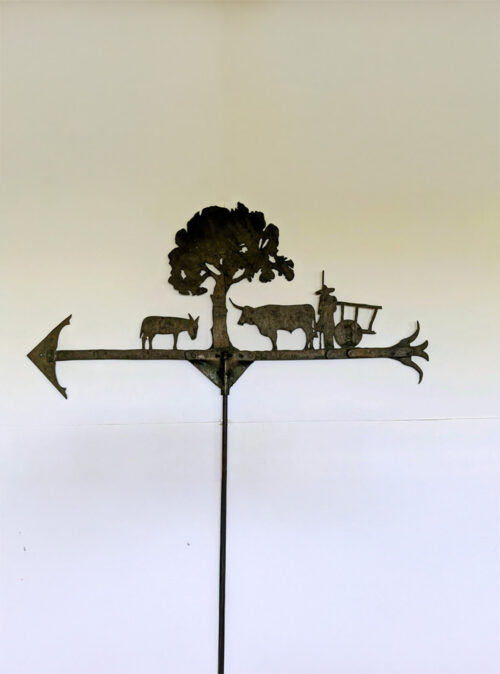
Oxcart, San Fernando Valley Ranch, 1920s, Copper, from the Marty Newman Collection
North Wing, Burra Family Community Room
Wind from the West: California Iron Weathervanes
June 17, 2026 – November 1, 2026
Curated by Mary Platt
Weathervanes as Art? About the Exhibition
What is the history of weathervanes in Southern California?
Long before mass-produced décor and catalog-ordered ornament became commonplace, homeowners and builders across California commissioned unique iron weathervanes to crown rooftops, towers, garages, stables and gardens. Especially in the growing resort communities of Southern California during the 1920s and 1930s, these handcrafted creations became a whimsical form of architectural self-expression — part utility, part sculpture and part personal signature.
The weathervanes in this exhibition come primarily from Palm Springs and neighboring desert communities, where wealthy residents, movie stars, architects and developers transformed the region into one of California’s most glamorous enclaves. In an era fascinated with romantic visions of the Spanish Southwest and Old California, homeowners often worked closely with architects to create residences rich in fantasy and personality. Weathervanes became one more opportunity to add charm, humor and individuality to a property.
What techniques were used to craft iron weathervanes?
Most of these pieces were fabricated from flat sheets of black iron, carefully cut by local ironworkers and smiths into striking silhouettes. Though the names of many of the makers have been lost to time, their craftsmanship and imagination remain vividly alive. The silhouettes are at once bold and elegant, designed to be instantly recognizable against the bright desert sky.
What designs appear most often in California weathervanes?
Certain motifs became especially popular. The proud silhouette of a Spanish galleon — sails billowing in an imaginary wind — appeared atop countless homes, evoking California’s romantic colonial past. Mounted cowboys, stagecoaches, bullfighters, mission scenes and horse-drawn wagons reflected enduring fascination with the mythology of the West and Spanish California. Other vanes celebrated leisure and modern life: golfers mid-swing, swimmers cutting through stylized waves, speeding automobiles and roaring locomotives. Desert imagery appears frequently as well, with roadrunners, cacti and scenes inspired by Mexico and the Coachella Valley landscape.
Some designs are playful and deeply personal. One of the exhibition’s most memorable examples is the dashing figure of fictional hero Zorro on horseback (Zorro was created in 1919 by American pulp writer Johnston McCulley). Topping another vane is a cut-iron interpretation of the famous winged horse logo of Mobil Gas, created especially for the roof of a local service station.
Why are California weathervanes considered American folk art?
Although weathervanes originated as useful devices for indicating wind direction, the examples in this exhibition transcend pure function. They belong to a rich tradition of American folk art — art created not for museums or galleries, but for everyday life. Their anonymous makers combined technical skill with theatrical flair, creating objects that delighted passersby while contributing to the distinctive character of California architecture.
Today, these surviving weathervanes offer glimpses into a vanished world of craftsmanship and regional fantasy. Silhouetted against the sky, they once danced and pivoted in the desert winds above homes, ranches, garages and businesses. Seen together, they reveal a uniquely Californian blend of romance, optimism, humor and invention — enduring symbols of an era when even the rooftops were designed to spark the imagination.
All weathervanes in this exhibition are on loan from the Marty Newman Collection
Tickets/Reservations
The Hilbert Museum recommends FREE online reservations for entry. Guests who arrive without a reservation will be assisted by our staff as available and admitted as space permits. We look forward to seeing you!